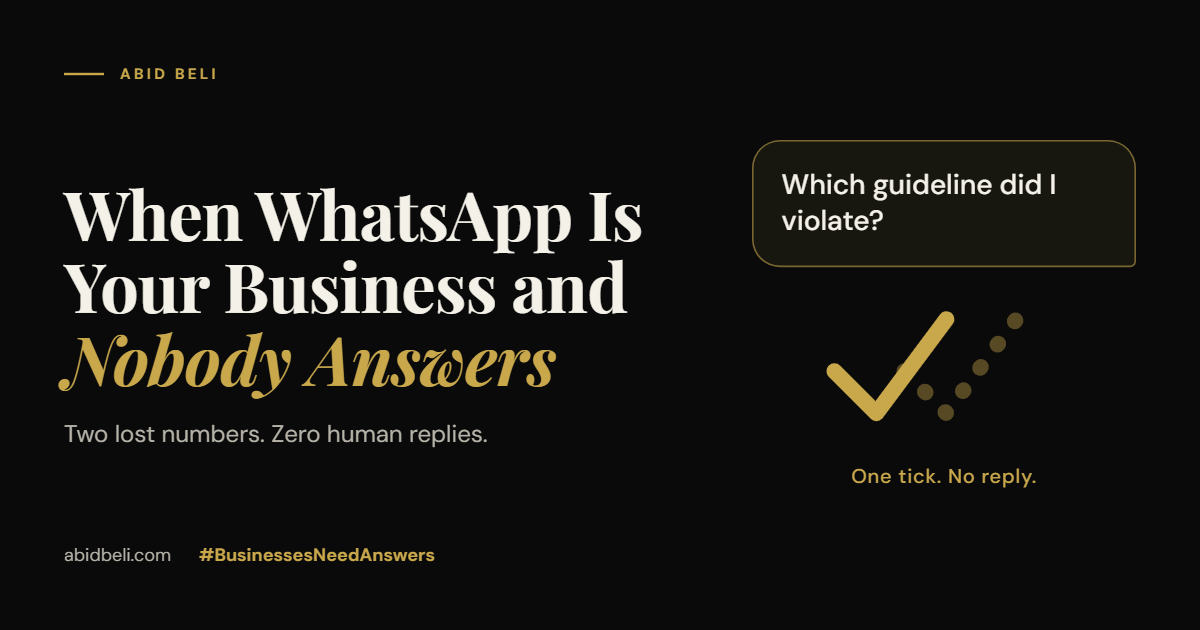
For more than twelve years, one of my WhatsApp numbers was the backbone of my business life. It held business contacts, client conversations, supplier chats and groups I had built relationships in over more than a decade. Then, about nine months ago, WhatsApp banned it.
The reason I was given was that I had "violated community guidelines." I asked a simple question, again and again, through every channel I could find: which guideline? I filled in forms. I sent emails. I used the help pages. The answer never changed, and it never got more specific. A twelve-year-old business asset was gone, and no one could tell me why.
I rebuilt on a new number. I kept going. That is what entrepreneurs do.
Then, this week, another of my WhatsApp Business numbers was hacked.
I reported it immediately, through every support route available. Days later, I have not received a single reply from WhatsApp.
Here is what happened next. I messaged the person who took over my account and asked what they wanted. The answer: $200, sent to a PayPal account, and they would "return" my account. I refused. Since then, every message I send to my own number shows a single tick. I still hold the SIM. I even replaced it with a new one from my mobile operator, in case the SIM was the problem. Yet for days, no verification code arrived, by SMS or by voice call. The app simply told me to try again in seven hours, and then in seven hours, and then in seven hours.
Once, a code did arrive. I was relieved for about a minute. When I tried to log in, I found that the attacker had set a new two-step verification password and added their own email address. I never received a single notification that my password had been reset or my email changed. The one protection that should have warned me stayed silent.
And here is the part that I think every business owner should understand. When I asked WhatsApp to let me recover my own number, which I own, on a SIM I hold in my hand, the system told me to wait seven days. Seven days. During that time, the person who stole my account sits on my business number, on their own phone, free to talk to my customers, my suppliers and my friends. The real owner waits. The thief does not.
For a business, seven days is not an inconvenience. It is lost orders, lost trust, and a real risk that my contacts will be asked for money by someone pretending to be me.
I want to be fair. WhatsApp is a remarkable product, and I have used it happily for years. Its own help pages explain that a review can be requested after a ban, and that a waiting period applies when two-step verification is set by someone else. I understand why such rules exist. But rules without a human being behind them fail the very people they are meant to protect.
I am not asking for special treatment. I am asking for something basic:
1. A real human escalation path for verified business owners whose accounts are banned or hijacked.
2. A clear explanation of which policy was violated, so honest users can fix it and bad actors cannot hide behind vagueness.
3. An immediate alert, on every channel, when two-step verification settings or the recovery email are changed.
4. A faster, safer path to recover a hijacked number for the genuine owner, with a defined response time for hacked-account reports. Every hour matters when someone else is talking to your customers.
This is not only my story. Millions of small businesses across Pakistan, India, Africa, Latin America and the Middle East run their sales, support and payments on WhatsApp. For them, an account is not a hobby. It is customers, income and trust. When an account is lost without explanation or recovery, a business can be lost with it.
I am writing this publicly for two reasons. First, I hope someone at WhatsApp and Meta will read it and give my two cases a real human review. Second, I know I am not alone, and I believe the people affected deserve to be heard together.
QUESTION FOR YOU:
Has your WhatsApp account, business or personal, ever been banned or hacked? How long did recovery take, and did anyone from WhatsApp ever respond? Share your story in the comments or on social media with #BusinessesNeedAnswers. If enough of us speak up, it becomes much harder to ignore.
- Abid Beli
Entrepreneur, Founder of WorkMore, Author | abidbeli.com